
Book Now

Dental Implants, Placed with Precision

A lasting replacement for missing teeth — planned with CBCT 3D imaging and placed to a detailed surgical guide, before anything is left to chance.

Any surgical or invasive procedure carries risk. A detailed assessment is completed before treatment proceeds.

01 / Why dental implants

A Fixed Replacement That Functions Like a Natural Tooth

A dental implant is a three-part system designed to replace a missing tooth at the root — a treatment approach supported by over 50 years of clinical research. A titanium post is surgically placed into your jawbone, where it bonds with the bone over several weeks through a biological process called osseointegration. An abutment — a small connector — is then attached to the post, and a custom porcelain crown is fitted on top. The result is a fixed, non-removable tooth that looks, feels, and functions like the one you lost.

Unlike a traditional bridge, an implant does not require the teeth on either side of the gap to be ground down. Unlike a removable denture, it does not shift during eating or speaking, and it does not rely on adhesives to stay in place.

Implants also help preserve jawbone density at the site of the missing tooth. The Australian Institute of Health and Welfare (AIHW) reports that approximately 25% of Australians aged 65 and over have lost all their natural teeth — and bone resorption following tooth loss is a contributing factor to facial structure changes over time. An implant maintains mechanical stimulation to the bone, slowing the resorption process.

Dental implants are a long-term, fixed replacement — designed to last for many years with appropriate care. Whether one tooth is missing or several, an implant-based solution is assessed individually based on your bone density, oral health, and medical history.

Explore implant types and options
Understanding dental implants — titanium post placement with Dr Singh at Sienna Smiles, Hilbert
02 / Implant types

Four Implant Solutions, Each Matched to Your Case

Single Tooth Implant

Replaces: One missing tooth

One titanium implant post supports one porcelain crown — replacing a single missing tooth without altering the teeth beside it. This is the most common implant case at Sienna Smiles. CBCT 3D imaging maps the position of surrounding teeth and nerve pathways before placement, so the implant is positioned with sub-millimetre accuracy relative to your existing anatomy.

Typical timeline: 3–6 months from placement to final crownView single implant pricing

Implant-Supported Bridge

Replaces: Two to four adjacent missing teeth

Two implant posts support a bridge framework with multiple porcelain teeth — replacing a span of missing teeth without grinding down the healthy teeth on either side. A traditional bridge requires altering adjacent tooth structure to anchor the replacement. An implant-supported bridge preserves those teeth entirely, with each implant placed using CBCT-guided planning to account for remaining roots and bone.

Typical timeline: 4–6 monthsView implant bridge pricing

Implant-Supported Denture

Replaces: Multiple missing teeth (removable option)

If you currently wear a removable denture that shifts during eating or requires adhesive to stay in place, implant-supported dentures offer an alternative. Two to four implants per arch anchor the denture using precision attachments. The denture clips in for stability and clips out for cleaning. No adhesives. No movement during meals or conversation. This is a removable prosthesis on a fixed foundation — suitable for patients who want the stability of implants with the familiarity of a denture they can take out to clean.

Typical timeline: 3–6 months for implant integration, then 2–4 weeks for denture fabricationView implant denture pricing

Full-Arch Implants (All-on-4 / All-on-6)

Replaces: An entire arch of teeth (fixed, non-removable)

Full-arch implant treatment replaces every tooth in an upper or lower arch with a fixed prosthesis supported by four to six implants. The prosthesis is non-removable — it functions like natural teeth for eating, speaking, and daily life. In eligible cases, a temporary prosthesis can be attached on the same day as surgery, giving you functional teeth while your jawbone bonds with the implants over the following months. The final prosthesis is fabricated after osseointegration is confirmed and replaces the temporary restoration. This is the most comprehensive implant treatment available, and the highest investment. Dr Singh assesses each full-arch case individually, with a CBCT scan and written cost outline provided before any commitment is made.

Typical timeline: Same-day temporary teeth (eligible cases), 4–6 months osseointegration, then final prosthesis fabricationView full-arch pricing

Any surgical or invasive procedure carries risk. A detailed assessment is completed before treatment proceeds. The right solution depends on your individual case — this is assessed at your complimentary consultation.

Your implant consultation is complimentary

A CBCT scan, a 3D treatment plan presented on-screen, and a written cost outline — before you commit to anything. No obligation to proceed.

03 / Treatment process

Your Implant Treatment, Step by Step

Implant treatment is not a single-visit procedure. The process typically spans three to six months, depending on your case. Here is what happens at every stage.

  1. Complimentary Consultation and CBCT Scan

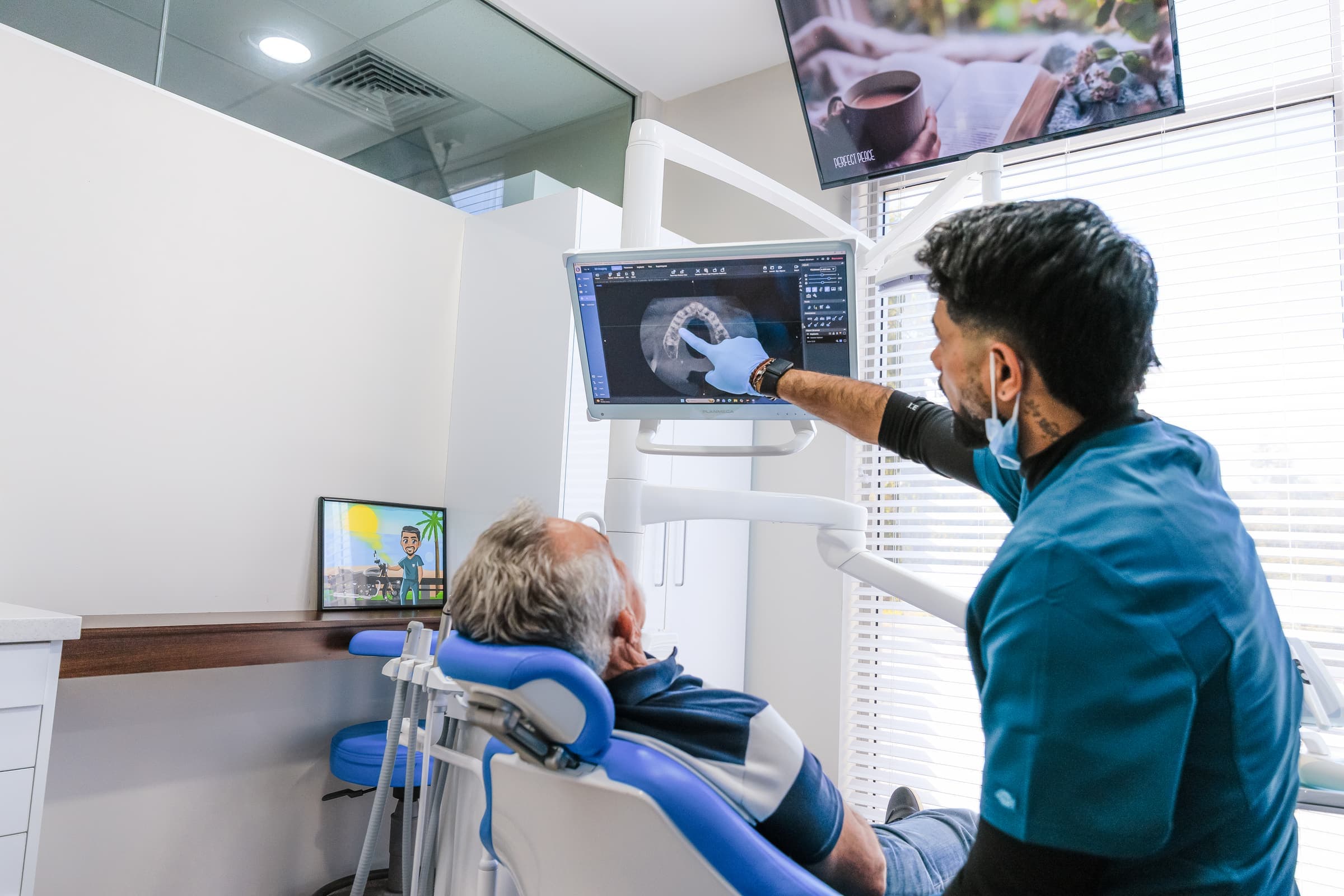
    Your first visit includes a CBCT 3D scan of your jaw — capturing bone density, nerve pathways, sinus proximity, and surrounding tooth roots in a single image. Clinical photographs and a digital intraoral scan are taken. Dr Singh reviews the imaging with you on-screen, discusses your medical history, and develops a 3D treatment plan. You leave with a written cost outline. This consultation is complimentary for implant patients.

    Duration: 60 minutes
  2. Treatment Planning

    Dr Singh reviews the CBCT data in detail and develops the surgical plan. A digital surgical guide — a custom 3D-printed template that directs exact implant positioning — is fabricated. If bone grafting is required, it is discussed and scheduled at this stage. You receive a finalised written treatment plan with all costs itemised before any procedure is booked.

    Duration: 1–2 weeks
  3. Implant Placement

    The titanium implant post is placed into the prepared site using the surgical guide, under local anaesthetic. For full-arch cases, a temporary prosthesis may be attached on the same day where clinically appropriate. Sedation options are available and quoted separately.

    Duration: 45–120 minutes, depending on complexity

    Any surgical or invasive procedure carries risk. A detailed assessment is completed before treatment proceeds.

  4. Healing and Osseointegration

    Your jawbone gradually bonds with the titanium implant surface — a process called osseointegration. The implant is typically left undisturbed during this period. You follow post-operative care instructions provided at your appointment, including soft diet guidelines and oral hygiene protocols. Regular review appointments monitor healing progress. This period is critical to the long-term stability of your implant.

    Duration: 8–12 weeks (lower jaw) / 12–16 weeks (upper jaw)
  5. Abutment and Impressions

    Once osseointegration is confirmed, the abutment — a small connector piece — is attached to the implant post. A digital intraoral scan is taken to fabricate your final crown, bridge, or prosthesis. Shade matching ensures the porcelain blends with your surrounding teeth.

    Duration: 30–60 minutes
  6. Final Restoration

    Your custom-fabricated crown, bridge, or prosthesis is fitted and adjusted. Bite alignment is checked and refined. You receive care instructions for long-term maintenance. Follow-up appointments are scheduled at one week, one month, three months, and then six-monthly ongoing.

    Duration: 60–90 minutes
05 / Technology

The Technology Behind Your Implant Treatment

Every piece of technology used in your implant treatment is named here because you should know what is being used and why it matters to your case.

CBCT 3D Scanner

Captures a three-dimensional image of your jawbone, nerve pathways, sinus position, and surrounding teeth. Dr Singh uses this data to plan implant placement with sub-millimetre accuracy — identifying bone density and anatomical structures before surgery, not during it.

Digital Intraoral Scanner

Replaces traditional impressions with a sub-millimetre-accurate digital scan. No trays, no impression material. The scan is used to fabricate your crown, bridge, or prosthesis with precision that translates directly to fit.

3D Treatment Planning Software

Your treatment plan is developed digitally and presented on-screen during your consultation. You see exactly what is proposed — implant position, angle, depth — before any work begins.

Surgical Guide (3D-Printed)

A custom template fabricated from your CBCT data that guides exact implant positioning during the placement procedure. It translates the digital plan into physical precision during surgery.

06 / Patient outcomes

Patient Outcomes at Sienna Smiles

Each case below represents a specific implant treatment completed at Sienna Smiles. The images are presented without digital enhancement beyond standard photographic correction. Results depend on individual clinical factors including bone quality, oral health, and treatment compliance.

Use the left and right arrow keys to move the comparison slider. Press Home for the full before view or End for the full after view.

Before
After

Single implant placement, upper right central incisor. Presenting concern: missing tooth following trauma. Outcome at six months post-placement. One implant placed.

Before
After

Implant-supported bridge, lower left posterior region. Presenting concern: three adjacent missing teeth. Outcome at eight months post-placement. Two implants placed.

Before
After

Implant-supported denture, upper arch. Presenting concern: ill-fitting removable denture. Outcome at twelve months post-placement. Four implants placed.

Before
After

Full-arch restoration (All-on-4), lower arch. Presenting concern: multiple failing teeth requiring extraction. Outcome at twelve months post-placement. Four implants placed.

Individual results vary. These images represent outcomes achieved for specific patients under specific clinical conditions. Your results may differ based on your oral health, bone quality, and treatment compliance.

Any surgical or invasive procedure carries risk. A detailed assessment is completed before treatment proceeds.

06 / Frequently asked questions

Common Questions About Dental Implants

The implant placement is performed under local anaesthetic, so you should not feel pain during the procedure itself. A 2021 systematic review published in Clinical Oral Implants Research found that most patients rated post-operative discomfort as mild, with peak discomfort occurring within the first 24 to 48 hours and resolving within three to seven days. Most patients manage recovery with over-the-counter pain relief such as paracetamol or ibuprofen, taken as directed. [Sedation options](/sedation-dentistry) — including nitrous oxide and oral conscious sedation — are available if you prefer additional comfort, and are quoted separately at your consultation. Discomfort levels vary between patients depending on the complexity of the procedure and individual factors.

A complimentary consultation. A CBCT scan. A written plan with costs.

Your implant consultation with Dr Singh includes a CBCT 3D scan reviewed on-screen, a comprehensive assessment, and a written treatment plan you take home. There is no cost for the consultation and no obligation to proceed.

Any surgical or invasive procedure carries risk. A detailed assessment is completed before treatment proceeds.