
PorcelainVeneers, Designed toYourFacialProportions
Addressing chips, discolouration, and uneven edges with results shaped around your facial anatomy — not a template. Porcelain is selected for its natural translucency, refracting light the way enamel does. Dr Singh has been practising in Australia since 2011.
Cosmetic dental treatments involve clinical assessment. Suitability, expected outcomes, and alternatives are discussed in full before you consent to any treatment.
Porcelain Veneers, Designed to Your Facial Proportions
Addressing chips, discolouration, and uneven edges with results shaped around your facial anatomy — not a template. Porcelain is selected for its natural translucency, refracting light the way enamel does. Dr Singh has been practising in Australia since 2011.
Cosmetic dental treatments involve clinical assessment. Suitability, expected outcomes, and alternatives are discussed in full before you consent to any treatment.
A Thin Porcelain Shell, Shaped and Shaded to Correct What You See in the Mirror
Chipped edges, discolouration that whitening cannot reach, uneven tooth lengths, surfaces worn flat over years of use — porcelain veneers are designed to address these specific concerns. Each veneer is a thin shell of dental ceramic, typically 0.3 to 0.5mm, bonded to the front surface of your tooth.
Porcelain is selected for its natural translucency — it refracts light the way enamel does, producing a result that blends with your surrounding teeth. Dr Singh maps each case to your facial proportions, matches shade under multiple lighting conditions, and previews the design digitally before a single tooth is prepared. Suitability is assessed individually during your consultation.
Tooth preparation involves removing a thin layer of enamel. This is a permanent modification — your teeth will require veneer or crown covering from this point onward. This is discussed in full before any preparation begins.
Content reviewed by Dr Abhishek Singh, AHPRA DEN0001639626.
Porcelain and Composite Veneers — Understanding the Difference
Both porcelain and composite veneers address cosmetic concerns. The right choice depends on your specific case, your budget, and the longevity you are looking for. This comparison presents both options as they are — so the decision is yours, informed by fact rather than assumption.
Typical lifespan
10–15 years with proper care. Longevity varies between patients. Porcelain veneers may chip, fracture or debond and may require repair or replacement over time.
5–7 years on average. Longevity varies between patients. Composite veneers may stain, chip or wear and may require repair or replacement over time.
Stain resistance
Non-porous surface resists staining from coffee, wine, and other dietary sources.
Porous material that may discolour over time.
Translucency
Mimics the light-refracting properties of natural enamel — difficult to distinguish from natural teeth when properly shade-matched.
Moderate translucency. Can appear less natural in certain lighting conditions.
Tooth preparation
0.3–0.5mm of enamel removed from the front surface. This is irreversible — your teeth will always require covering once prepared.
Minimal or no tooth preparation required in many cases. Often preserves natural tooth structure entirely.
Visits required
2–3 visits over 2–4 weeks. Veneers are fabricated in an external dental laboratory.
Typically completed in a single visit. Shaped directly on the tooth chairside.
Repairability
Cannot be repaired if chipped or cracked — the veneer must be replaced.
Can often be repaired or patched chairside without full replacement.
Cost (Perth, 2026)
From $1,200 per veneer.
From $450 per veneer.
Dr Singh discusses both options at your consultation and recommends based on your specific concerns, budget, and long-term goals. For patients seeking a simpler approach, teeth whitening may address shade concerns without veneer preparation. Neither option is inherently the right one — the right one is the one that matches your case.
See what your veneers could look like. A smile design consultation starts with your face, not a template.
Your consultation with Dr Singh includes a digital smile design preview, assessment of your teeth and facial proportions, a discussion of porcelain and composite options, and a written cost outline. No obligation to proceed.
Your Veneer Treatment, Step by Step
Porcelain veneer treatment is not a single-visit procedure. The process typically spans two to four weeks, from your initial consultation to the final bonding. Here is what happens at every stage — with realistic timeframes, so you know what to expect before you begin.
Consultation and Assessment
45–60 minutesYour first appointment is a thorough clinical assessment — not a decision you need to make on the day. Dr Singh examines your teeth, gums, and facial anatomy, takes periapical X-rays or CBCT imaging where indicated, and discusses the cosmetic concerns you want to address. You leave this appointment with a clear picture of whether veneers are appropriate for your case.
Digital Smile Design and Shade Selection
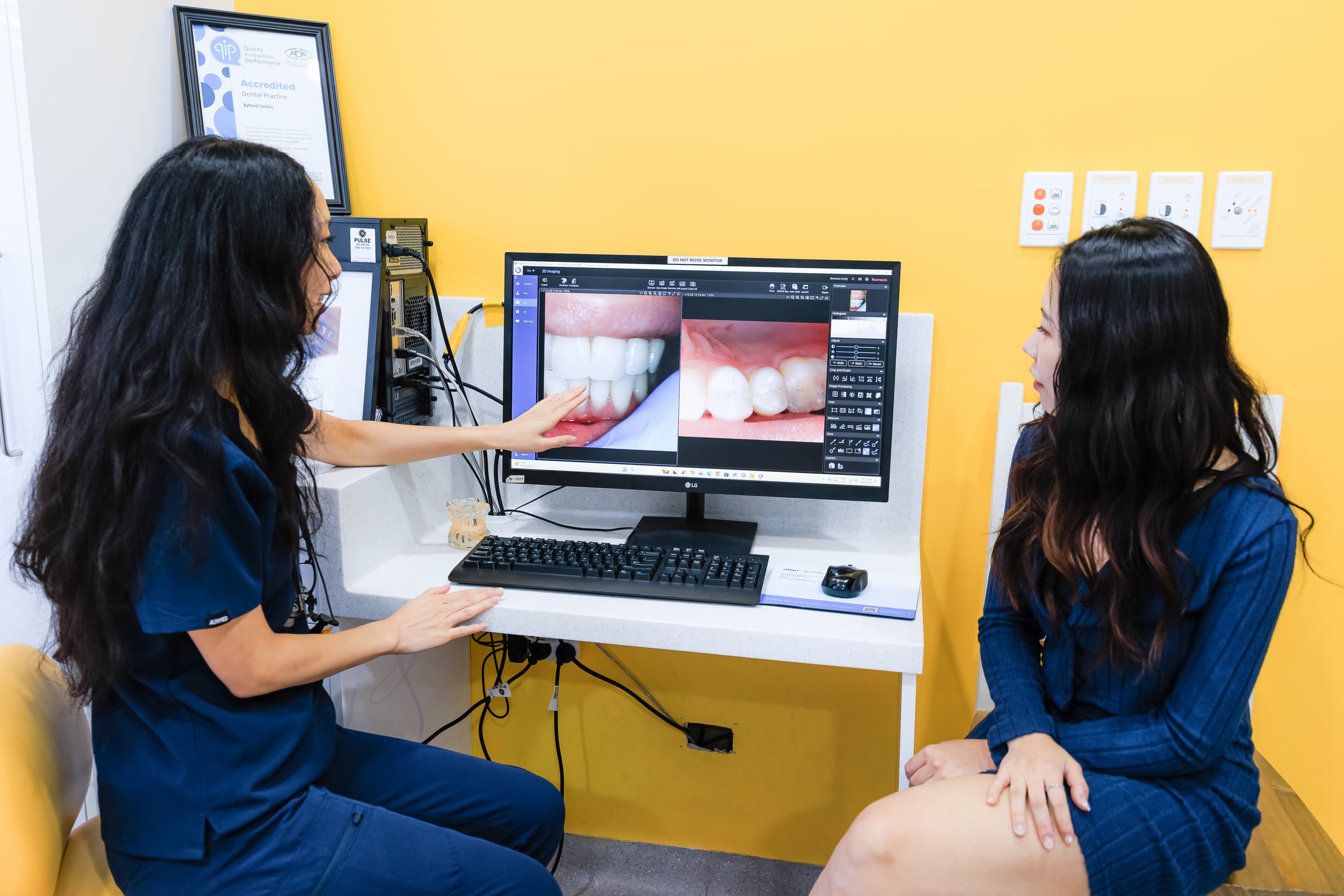
Included in consultation or scheduled separatelyUsing digital smile design software, Dr Singh maps veneer proportions to your facial anatomy — tooth width, length, gum line symmetry, and midline alignment are assessed against your face, not a generic template. Shade is selected by matching porcelain colour against your surrounding teeth and skin tone under multiple lighting conditions. You see a projected result on-screen and can provide feedback on shape, shade, and proportion before any preparation begins. The digital preview gives you a clear indication of the expected result — and a chance to adjust before treatment proceeds. This is a projected result based on your clinical assessment. Individual outcomes vary depending on tooth condition, preparation, and material characteristics.
Tooth Preparation
30–60 minutes per arch, under local anaestheticA thin layer of enamel (0.3–0.5mm) is removed from the front surface of your teeth. This is a permanent modification — your teeth will always require some form of covering once prepared. This is discussed in full before you consent to treatment. Thin-prep techniques preserve as much natural tooth structure as clinically appropriate. The preparation creates space for the veneer to sit flush with your natural tooth line.
Impressions and Temporaries
Same appointment as preparationA digital intraoral scan captures your prepared teeth to sub-millimetre accuracy. This scan, along with the digital smile design specifications, is sent to an external dental laboratory for veneer fabrication. Temporary veneers are placed to protect your prepared teeth during the fabrication period.
Bonding and Follow-Up
60–90 minutes (bonding), 15–30 minutes (follow-up review at 1–2 weeks post-bonding)Your veneers are tried in, adjusted if necessary, then permanently bonded using adhesive cementation with light curing. Bite alignment is checked and refined. A follow-up review is scheduled one to two weeks after bonding to assess fit, bonding integrity, and your feedback on aesthetics and comfort.
Content reviewed by Dr Abhishek Singh, AHPRA DEN0001639626.
Patient Outcomes at Sienna Smiles
Each result below reflects the digital smile design and shade-matching process described above. The images are presented without digital enhancement beyond standard photographic correction. Results depend on individual clinical factors.
Use the left and right arrow keys to move the comparison slider. Press Home for the full before view or End for the full after view.
Four upper anterior porcelain veneers addressing chips and mild discolouration. Treated by Dr Singh.
Six upper anterior porcelain veneers addressing uneven tooth lengths and worn edges. Treated by Dr Singh.
Eight composite veneers addressing minor chips and shade inconsistency. Completed in a single visit. Treated by Dr Singh.
Four upper anterior porcelain veneers addressing discolouration and mild spacing. Treated by Dr Singh.
Individual results vary. These images represent outcomes achieved for specific patients under specific clinical conditions. Your results may differ based on tooth condition, oral health, shade selection, and treatment compliance.
Common Questions About Porcelain Veneers
Answers reviewed by Dr Singh, AHPRA DEN0001639626.
Risks and Considerations of Porcelain Veneers
Before you decide whether veneers are right for you, your dentist will talk through the clinical considerations that may shape your treatment plan.
Porcelain veneers involve permanent changes to the treated teeth, and some natural tooth structure may need to be removed. Potential risks and considerations include tooth sensitivity, gum irritation, changes to the bite, veneer chipping or fracture, debonding, and the possible need for repair or replacement over time.
Veneers are not suitable for every patient. Your oral health, tooth structure, bite and other individual factors can affect suitability and outcomes. Before treatment proceeds, your dentist will assess these factors and discuss the expected benefits, limitations, alternatives and relevant risks with you.
Your next step: a smile design consultation with a digital preview and written cost outline.
Your consultation with Dr Singh includes an assessment of your teeth, gums, and facial proportions, a digital smile design preview presented on-screen, a discussion of porcelain and composite suitability for your case, and a written cost outline you take home. No obligation to proceed.
Cosmetic dental treatments involve clinical assessment. Suitability, expected outcomes, and alternatives are discussed in full before you consent to any treatment.